Skin lesions
Skin tags and seborrhoeic warts
Soft tags on the neck and armpits, or rough brown warts on the body and face.
What is it?
Skin tags and seborrhoeic warts are harmless, but they can be quite a nuisance. They catch on a necklace, rub under a bra strap or stand out on the face.
They are two different lesions, each with its own cause. Neither is contagious, and they are usually gone in one or two treatments.
Skin tags
A skin tag (fibroma) is a small, soft growth of connective tissue, skin-coloured or slightly browner, sometimes on a thin stalk. You mainly find them where the skin rubs: on the neck, in the armpits, under the breasts and in the groin. They are more common with overweight, during pregnancy and in some families. Despite the Dutch name, a skin tag has nothing to do with a wart: no virus is involved.
Seborrhoeic warts
A seborrhoeic wart is rough, light to dark brown and looks stuck onto the skin, as if a blob of wax had dripped onto it. They are often found on the back, chest, face and hairline. They develop with age and predisposition; from around forty many people get them.
How we remove them
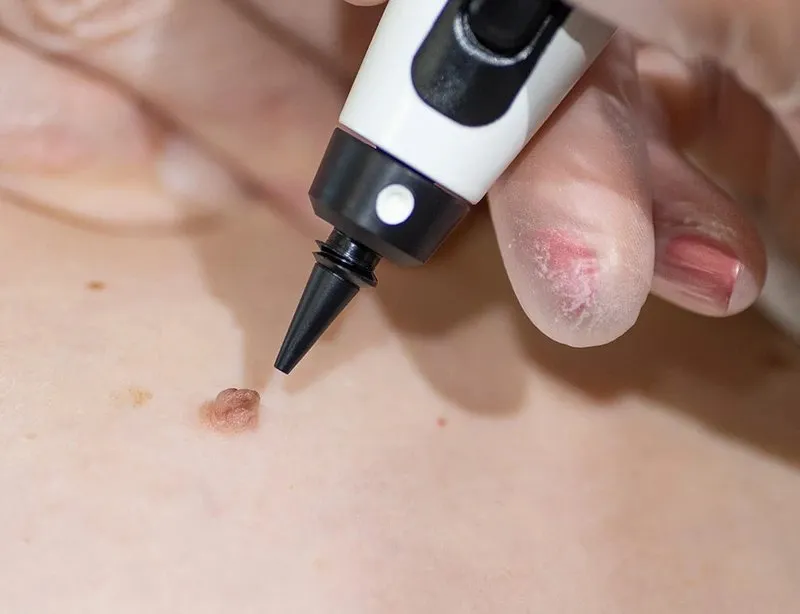
Before we remove anything, we look at the lesion carefully. Does it grow quickly, change colour or shape, or bleed? Then we refer you to your GP first. We usually remove skin tags with coagulation: a fine needle whose tip becomes warm. We treat seborrhoeic warts with cryotherapy or curettage. More on the lesion removal page and in our article on skin tags and seborrhoeic warts.
How we approach it
Every treatment plan starts with a free 30-minute intake. Your skin therapist examines your skin and discusses what you would like to achieve. We then draw up a treatment plan together. Sometimes one treatment is enough, sometimes we combine two. You also receive advice on caring for your skin at home.
Frequently asked questions
Does it hurt?
With coagulation you feel a short, warm prick. Cryotherapy feels cold and can sting briefly. For small lesions, anaesthesia is usually not needed.
Can I cut off or tie off a skin tag myself?
Better not. It can bleed heavily and become infected, and you cannot be sure it really is a skin tag. With us, we first check what it is, then remove it sterilely and neatly.
How long does recovery take?
After coagulation there is usually nothing left to see within a few days. After cryotherapy the scab falls off after 10 to 14 days. After curettage the graze heals in 1 to 2 weeks. On the face and neck, apply sunscreen for the first few weeks.
Do they come back?
The lesion we removed does not come back. People who are prone to them often develop new ones over time in the same kind of places. For seborrhoeic warts we advise coming back once a year; then they are still small and quickly removed.
Can they be removed at the intake?
Sometimes. The skin therapist first checks whether the lesion is benign and which method suits it. If there is time, it can be done straight away.
Is removal covered by insurance?
No. Removing benign lesions is cosmetic and is not covered.
How much does it cost?
One lesion costs € 60, two or three lesions € 80 and four or five lesions € 100. For more lesions we agree a price together. See also the prices page.
Treatments
Suitable treatments
Which treatment works best for you depends on your skin. These are the treatments we use most often for this concern.
Results
Before and after treatment
Every result is different. If a photo credits a source, it comes from another clinic that works with the same device. During the intake we discuss what you can expect.
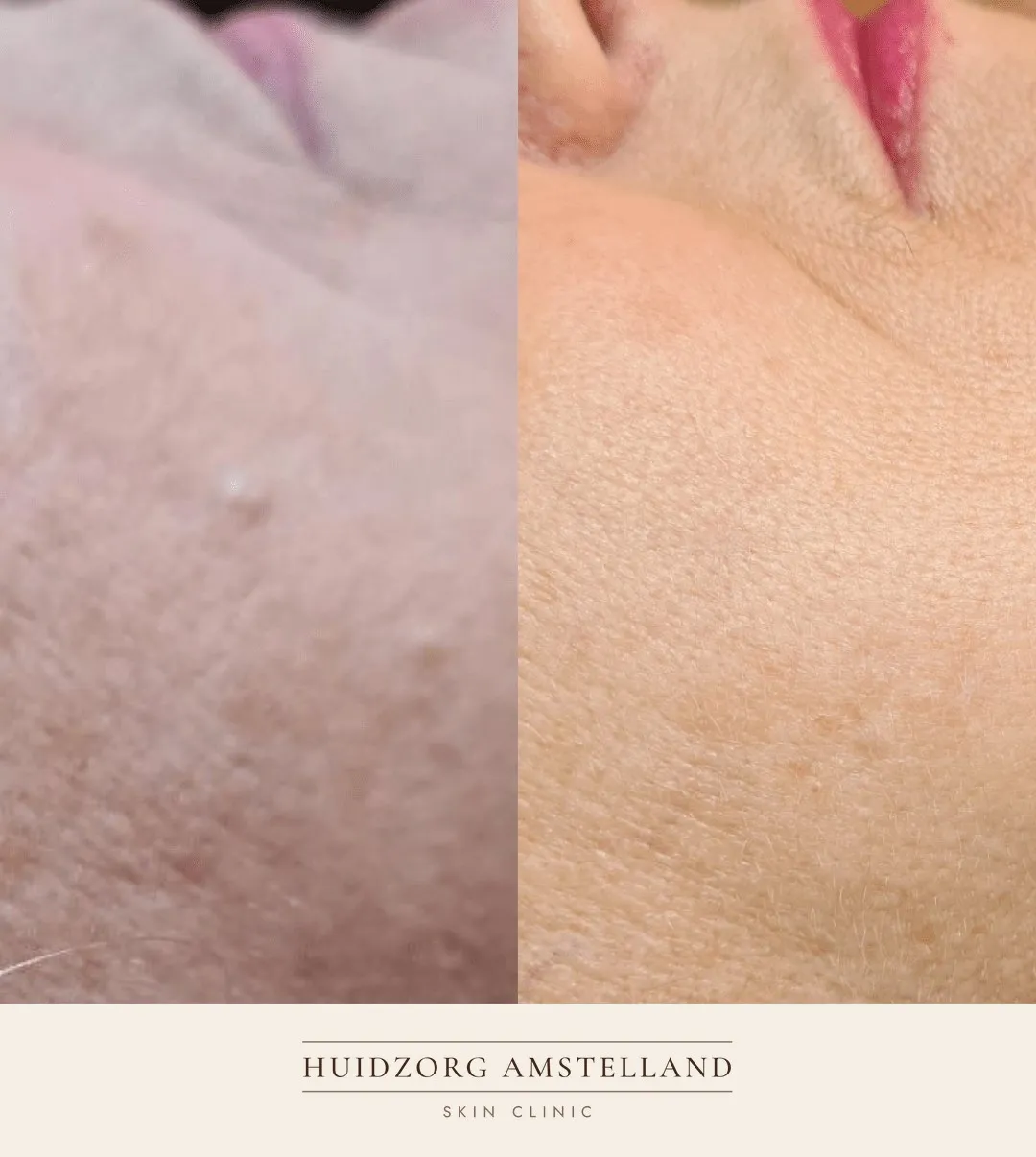
Removal of benign skin lesionsResult of coagulation therapy for enlarged sebaceous glands.View the treatment →
Questions about skin tags and seborrhoeic warts? We are happy to help.
Book a free intake. We look at your skin and tell you honestly what we can do for you.